


Chapter II. Signals of the Traffic Light and the Traffic Controller
4. Traffic lights use green, yellow, red and lunar-white light signals.
5. Depending on their purpose, traffic lights regulate the movement of vehicles, pedestrians or cyclists. Their signals may be circular (without a symbol), display one or more arrows or the silhouette of a pedestrian or bicycle, or be X-shaped.
6. Traffic lights with circular signals may have additional parts (sections) displaying one or two green arrows, positioned level with the green signal.
7. The round signals of the traffic light have the following meanings:
the green signal permits movement (countdown timers may be used to inform drivers and pedestrians, in seconds, of the time remaining until the end of the green signal);
the flashing green signal permits movement and indicates that its display period is ending and a prohibiting signal will soon appear;
the yellow signal prohibits movement (with the exception of the case provided for in point 19 of the Rules) and warns of the upcoming change of the signal;
the flashing yellow signal permits movement and indicates the presence of an uncontrolled intersection or pedestrian crossing and also warns of a hazard;
the red signal, including a flashing one, prohibits movement (countdown timers may be used to inform drivers and pedestrians, in seconds, of the time remaining until the end of the red signal);
the combination of the red and yellow signals prohibits movement and informs of the upcoming activation of the green signal.
8. The signals of the traffic light in the form of red, yellow and green arrows have the same meaning as the round signals of the corresponding color, however their effect applies only to the direction (directions) indicated by the arrows. In this case, the arrow permitting a left turn also permits a U-turn, if this is not prohibited by the corresponding road sign. The green arrow of the additional section has the same meaning. When the signal in an additional section is not illuminated, movement in the direction regulated by that section is prohibited.
9. Instead of red and yellow arrows, red and yellow round signals with black outline arrows may be used, having the same meaning.
10. The black outline arrow (arrows) on the main green signal of the traffic light informs drivers of the presence of an additional section and indicates the permitted directions of travel not covered by the additional section’s signal.
11. Bicycle-shaped signals are used to regulate cyclists, while pedestrian-shaped signals are used to regulate pedestrians. To regulate the movement of cyclists, a traffic light with round signals of reduced dimensions may also be used, together with a plate bearing the silhouette of a bicycle.
12. At locations where blind pedestrians frequently cross the road, the green traffic-light signal may be accompanied by an audible signal, distinct from vehicles’ special audible signals, to indicate that the carriageway may be crossed.
13. Reversible-lane traffic lights are used to regulate vehicles in individual carriageway lanes, particularly lanes whose direction of travel may be reversed. They have an X-shaped red signal and a green downward-pointing arrow, which respectively prohibit or permit travel in the lane above which they are installed. The main signals of reversible traffic lights may be supplemented with a yellow signal in the form of an arrow pointing diagonally downwards to the right or left, the activation of which informs of the upcoming change of the signal and of the need to change lanes into the lane indicated by the arrow. If the signals of a reversible-lane traffic light above a lane bounded on both sides by marking 1.9 are not illuminated, entry into that lane is prohibited.
14. For regulating the movement of trams, as well as other public transport vehicles moving along a separated lane, traffic lights with four round signals of a single color—lunar white—arranged in a "T"-shape may be used. Movement is permitted only when the lower signal and one or more of the upper signals are illuminated simultaneously: the left upper signal permits movement to the left, the middle signal straight ahead, and the right signal to the right. If one or more upper signals are illuminated without the lower signal, movement is prohibited.
15. The round flashing lunar white signal located at a railway crossing permits, and the red one prohibits, the movement of vehicles through the crossing. If both the flashing lunar-white and red signals are not illuminated, movement is permitted provided that no approaching train (locomotive or rail inspection vehicle) is visible.
16. The signals of the traffic controller have the following meanings:
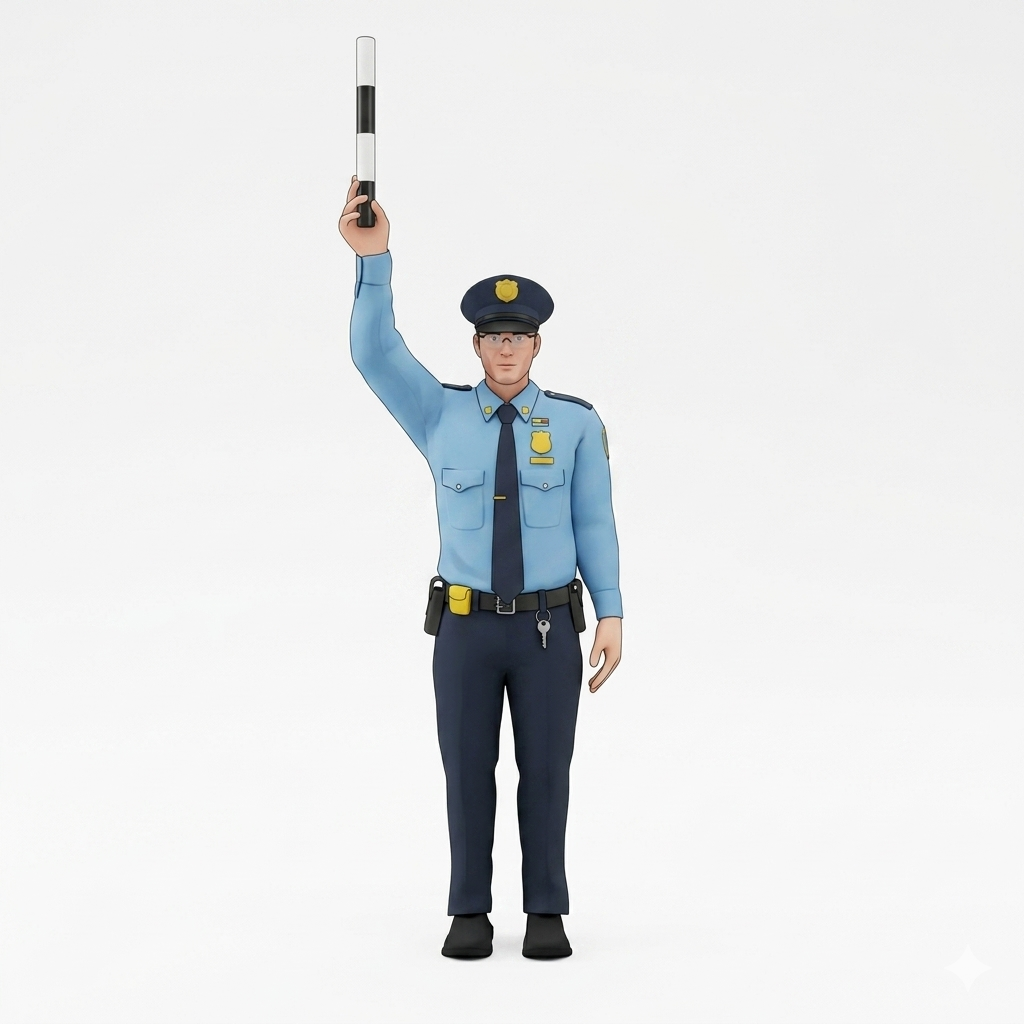
arm raised upwards
The movement of vehicles and the movement of pedestrians is prohibited, except for the cases provided for in point 19 of the Rules;
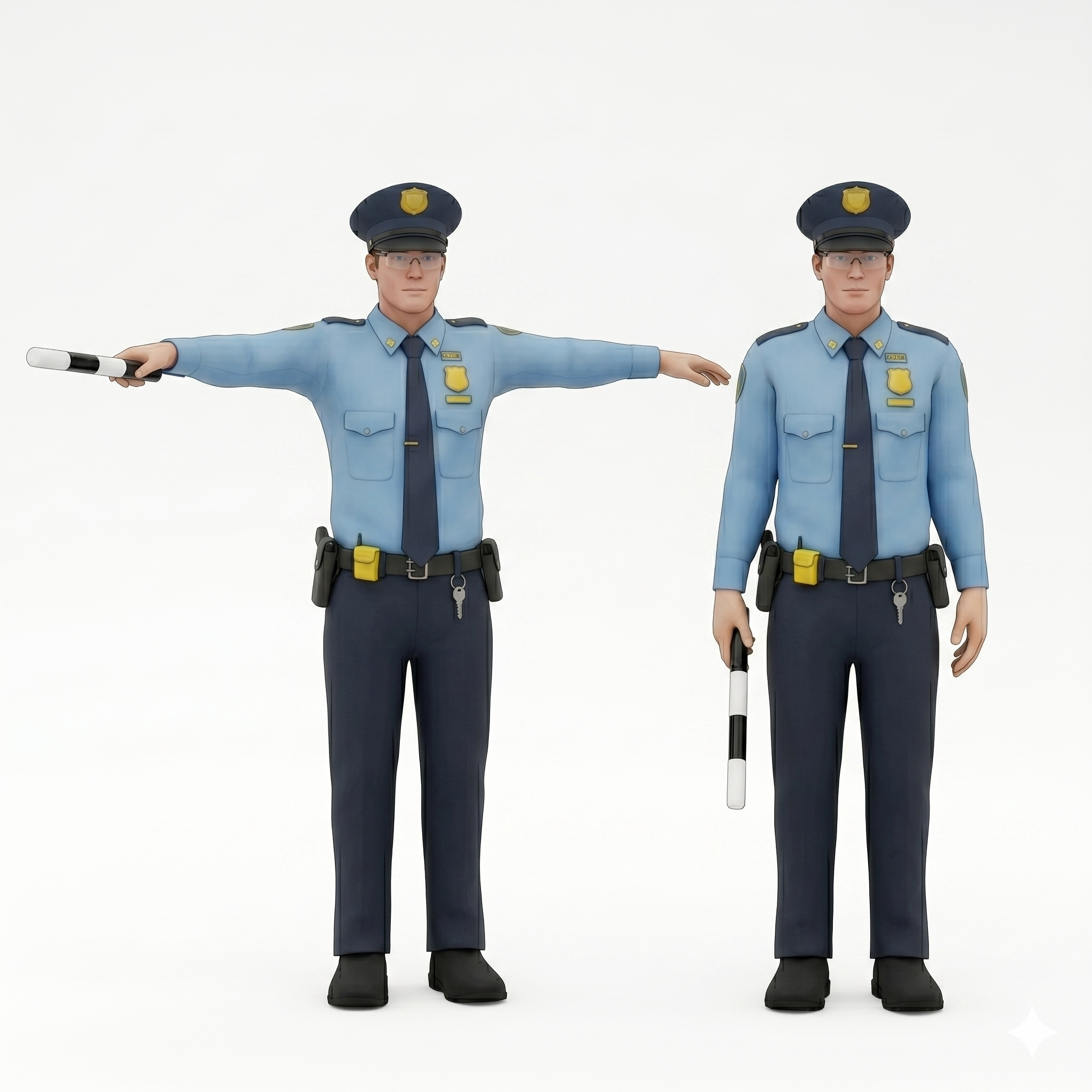
arms extended sideways or lowered
a. from the traffic controller’s left and right sides, non-rail vehicles may proceed straight ahead or to the right, while trams may proceed straight ahead. Pedestrians are permitted to cross the carriageway from the right and left sides of the controller;
b. from the traffic controller’s front and back, all vehicle and pedestrian movement is prohibited.
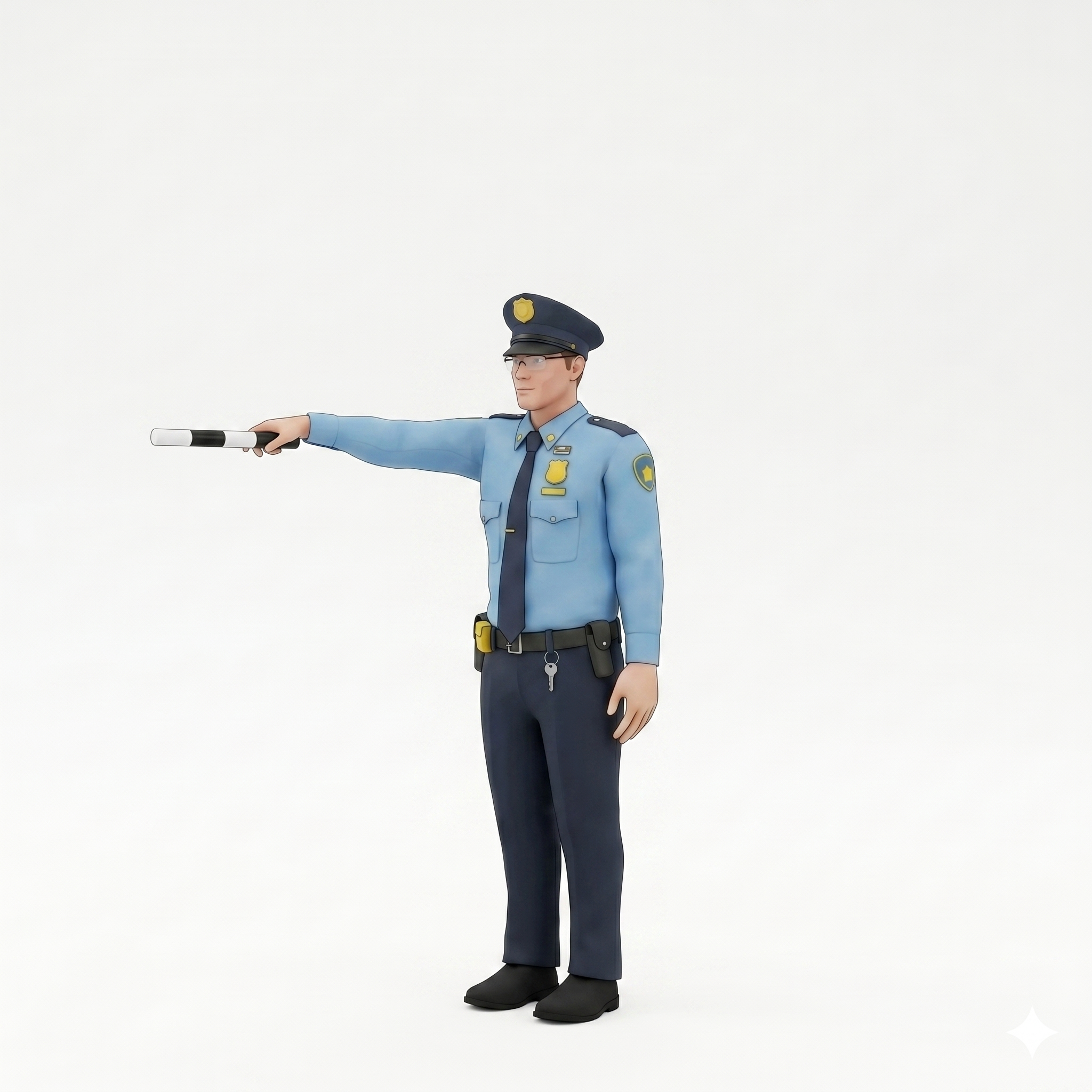
right arm extended forward
a. from the traffic controller’s left side, non-rail vehicles may proceed in all directions, while trams may turn left;
b. from the traffic controller’s front, all vehicles may turn right;
c. from the traffic controller’s back and right side, all vehicle movement is prohibited;
d. pedestrians are permitted to cross the carriageway behind the controller's back.
17. For better visibility of the signals, the traffic controller may use a traffic baton, including one with a red signal or a disc made of retroreflective material, and to attract the attention of road users he may also give signals with a whistle. The traffic controller may also give other signals by hand that are understandable to drivers and pedestrians.
18. In the case of a prohibiting signal of a traffic light (except a reversible one) or of the traffic controller, the driver must stop in front of the "Stop line" marking (or the 6.1 "Stop line" sign), and in its absence
before the intersecting carriageway, having regard to point 93 of the Rules and without impeding pedestrians;
in front of a railway crossing—in accordance with the requirements of point 111 of the Rules;
in other locations
in front of the traffic light or the traffic controller, without impeding the vehicles moving in the permitted directions and pedestrians.
19. When the yellow signal is activated or when the traffic controller raises his arm, those drivers who have no possibility of stopping at the places indicated in point 18 of the Rules without sudden braking may continue driving. With this signal, pedestrians on the carriageway must clear it, and if this is not possible, must stop on the line separating the traffic flows of opposite directions.
20. Drivers and pedestrians must comply with the orders and signals of the traffic controller, even in cases where they contradict the signals of the traffic light and the requirements of road signs or road markings.
21. At railway crossings, simultaneously with the red flashing signal of the traffic light, an audible signal may also be given, to provide road users with an additional warning that movement across the railway crossing is prohibited.